

While some electric violins come with machine tuners held in place by gears, most utilize wooden pegs that are designed to hold using friction.
If you have friction pegs--traditional ebony or other hardwood pegs inserted through holes in the pegbox of your instrument--it is not uncommon to have one or more that slips or won't hold tuning. We treat all friction pegs as part of our complimentary shop setup, but pegs can still lose their hold with changes in temperature and humidity, whether that is a seasonal change that takes place months after your receive your instrument, or on day one after it shipped in a hot or cold truck or from our humid environment to your drier one. If that happens, here is what you can do...
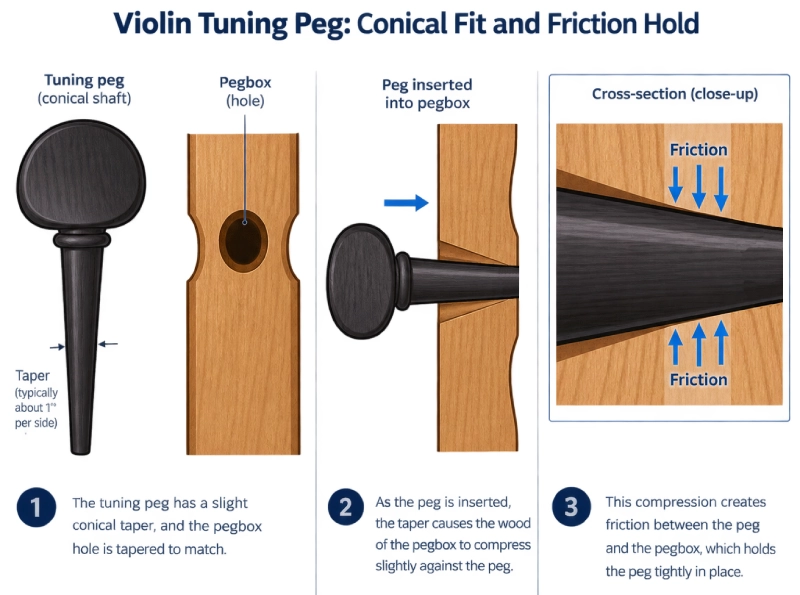
- Hold the instrument facing you (for violins or violas, place it upright on your lap, facing you) and turn the peg, tuning the string to pitch while also pushing firmly inward on the peg. The peg has a slightly conical shape, so as you push inwardly it gains friction with the surface of peg hole.
- If the peg still isn't holding after #1, look for 'peg compound' or 'peg dope.' Any violin shop, online specialty store, or even major online marketplaces should have it inexpensively. It's a clay-like substance that comes in a lipstick style tube. To apply it, pull the peg out just enough to expose the areas that contact the peg box and mark them with a small line of compound. Then do #1 again and you should get a good hold.
- Steps 1 and 2 ought to take care of your problem, especially for A strings and lower. However, the violin E peg is the more likely to slip due to the higher tension on that string, so once you get it to hold at something very close to E, just use the fine tuner to dial it in the rest of the way, and rely mainly on the fine tuner for all E-string tuning so you aren't moving the peg out of a position that is holding well.
From a maintenance perspective, it's good practice to apply a small amount of compound whenever you change strings to keep things turning smoothly and holding firmly. Very little compound is required--you can even draw a single line across the worn down ring where the peg engages, then turn the peg several times to smear that amount of compound evenly around the circumference of the peg and peg hole. Take string changes as an opportunity to add graphite to the string slots on your nut and bridge, too!
Geared Tuners
Do you find friction pegs difficult to use? Are you interested in an easier, more reliable tuner? Consider upgrading your instrument's pegs to ebony lookalike geared tuners! We offer both Knilling Perfection Pegs and Wittner FineTune pegs. Both work the same way, with internal mechanisms that provide both course and fine tuning without any significant force.
>> Shop geared lookalike violin tuners


