

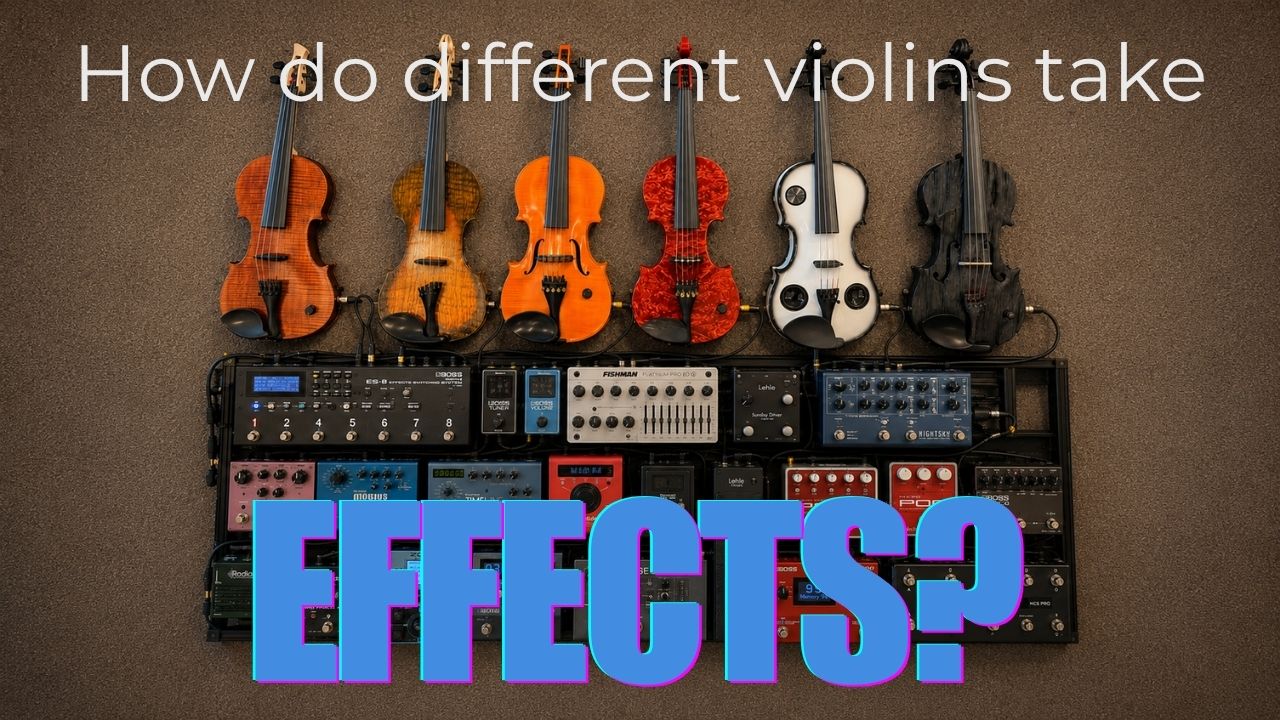
One of the most common questions customers have when choosing an electric violin is: How does this instrument take effects?
The short answer is simple: every electric violin will accept processing. Plug any of them into an effects chain and the effect will work. The more useful answer is that every violin has its own unprocessed voice, so each one brings something slightly different to the same effect.
Think of effects as processing the signal you give them. They do not erase the personality of the instrument at the start of the chain. A clean, bright, warm, focused, or more textured electric violin will all respond to distortion, organ-style processing, octave effects, and chorus, but the final sound will retain traces of that original character.
Key Takeaways
- Every electric violin will work with effects processing.
- Each instrument's clean tone remains part of its sound after effects are applied.
- Choose an electric violin for the clean voice you want to build upon.
- Different processed results reflect different source signals, not an inability to use effects.
Start With the Clean Sound
Before judging an electric violin through pedals or a multi-effects unit, listen to it clean. That clean tone is the foundation for everything that follows.

Even before any pedal is engaged, these instruments do not sound identical. That is not a problem to solve. It is exactly why choosing an electric violin is personal. The clean sound you enjoy is also the sound that will shape your effected sound.
What Changes When You Add Effects?
Effects do not change the signal the violin is sending, they only process the incoming signal from the violin. So while the same preset can be used across several instruments, the result will not necessarily be a carbon copy from one violin to the next.
The key point is this: different does not mean incompatible. A violin that sounds different when clean will sound different with processing, but it still accepts the processing perfectly well.
This matters when comparing instruments. Instead of asking whether one violin “takes effects” and another does not, ask which clean voice gives you the processed result you like best.
Distortion: The Original Voice Still Matters
Distortion is a great place to hear this principle clearly. It adds grit, drive, and harmonic content, but it works from the signal already coming out of the violin.
Running the same distortion through the Yamaha YEV, Realist RV5Pe, Zeta Jazz Fusion, Jordan 5, and Bridge Dragon Lyra shows that all five accept the effect. Yet their underlying tonal differences remain part of the sound.

That is the practical reality of an effects setup. A pedal is not a universal replacement for tone. It is a tool that transforms and builds upon the voice you feed into it.
Organ Machine Processing
Organ-style processing takes the electric violin into a completely different musical space, creating an organ-like texture from the bowed signal. This is a strong example of how far effects can take an electric violin.
The effect is clearly recognizable on each instrument. What changes is the character that reaches the effect in the first place. The violin remains an important part of the signal chain, even when the processing is dramatic.

Sub Octave: Building a Bigger Low End
A sub-octave effect adds a lower octave beneath the note you play. It is useful when you want more weight, a thicker texture, or a larger-than-life electric violin sound.
The comparison runs the sub-octave effect through each of the five violins. As with the other processing types, the effect is accepted by every instrument. The differences you hear are tied to the distinctive clean signal from each violin.
If a sub-octave setting feels especially good on one instrument, that does not mean the others cannot use it. It means that the particular combination of that violin and that effect suits the sound you have in mind.
Stereo Chorus: Width Without Losing Identity
Stereo chorus adds movement and width. It can make a single electric violin feel broader, more layered, and more spacious.
Through the Yamaha YEV, Realist RV5Pe, Zeta Jazz Fusion, Jordan 5, and Bridge Dragon Lyra, the chorus effect remains fully usable on every instrument. But the individual clean characteristics still influence the processed result.

Choose the Violin, Then Shape the Sound
There is no electric violin that refuses effects simply because it has a different clean tone. Every instrument in this comparison accepts distortion, organ machine processing, sub octave, and stereo chorus.
The real decision is not whether a violin can run effects. It is whether you like what that violin brings to your effects chain.
Start by finding an electric violin whose clean sound speaks to you. From there, effects become a way to expand that voice, whether you want drive, organ textures, deeper octave support, or a wide chorus sound.
Effects change the signal. They do not remove the instrument's identity.


